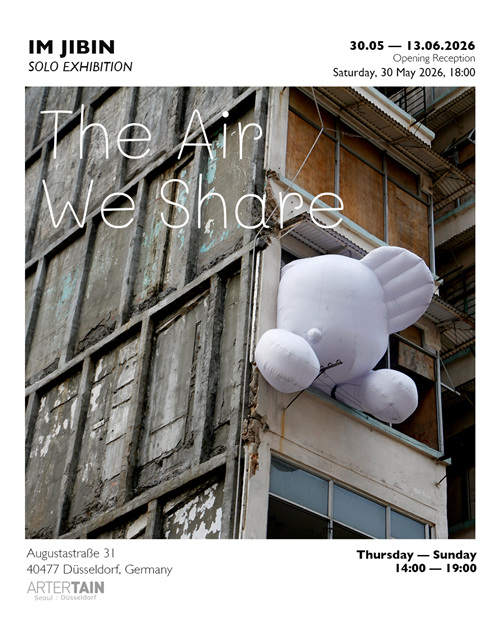
Title : The Air We Share
Date : 03. May. ~ 13. Jun., 2026
Place : Artertain (Augustastrasse 31, 40477, Duesseldorf. Germany)
Curator : Heeseung Hwang (+82 (0)2-6160-8445)
Dusseldorf,
03. May, 2026
The Air We Share
There is always air in the streets. Yet we rarely notice it. Air is
invisible and has no fixed form, passing freely through and between
all spaces. Precisely for this reason, however, air becomes one of the
most fundamental conditions of connection. We breathe through air; sound
travels through its vibrations; and a balloon acquires volume and presence
only when filled with it. Air, then, is not simply a natural element,
but an immaterial field of relations connecting one existence to another.


Within this context, Jibin Im’s Bear Balloon is far more than a sculptural
object based on a familiar character. It is a presence that comes into
being only by holding air within itself, while simultaneously functioning
as a symbolic device that reflects the structures of desire and emotion
in contemporary society. For many years, Im has worked with the familiar
form of BE@RBRICK as an appropriated object from popular culture. Observing
how the same toy-like form enters an entirely different system of value
when it encounters the languages of branding and capital, he has discovered
within it the structures of desire and the unstable identities that
characterize contemporary capitalist society.


The artist’s choice of the balloon as a material and sculptural form
is particularly significant. Unlike solid sculpture, a balloon can easily
sway, fold, inflate, and contract. It responds sensitively to its surroundings,
and the moment the air escapes, it returns to a powerless, flattened
surface. Perhaps this condition resembles our own existence in contemporary
society: constantly responding to external circumstances and expanding
under their influence, while remaining vulnerable enough to be unsettled
by even the smallest rupture.


Im has placed these Bear Balloons not only inside museums and galleries,
but also on streets, in public spaces, in natural environments, and
in unexpected locations. Giant bear-shaped balloons appear squeezed
between aging buildings, stand confidently in the middle of public squares,
or change their forms according to the wind and weather. These appearances
are not merely sculptural interventions. Rather, they operate as sensory
events that invite us to reconsider the relationships between the city,
its environment, and the people who inhabit it.


His practice is particularly significant in that it does not remain
confined to the white cube. Instead, it continuously moves through streets
and urban environments in what the artist calls Delivery Art. His work
does not remain static. Its sculptural language is completed through
movement, installation, and its encounters?sometimes collisions?with
the city itself. In this sense, the work also raises a question about
how art might exist not as something fixed within a particular institution,
but as something that actively enters the flow of everyday life. Since
2011, Im has continued these projects in cities around the world, demonstrating
how art can become not the possession of a particular place, but a sensory
experience open to anyone.


The exhibition The Air We Share extends this long-running project into
the urban context of Dusseldorf. Within a cityscape where industry and
art, historical urban structures and contemporary culture coexist, the
Bear Balloon takes its place like another breath of the city. Here,
“the air we share” does not simply refer to a physical space. It suggests
the emotions and desires that circulate through the city, the memories
and relationships that inhabit it, and the invisible currents of sensation
that pass between people. Im’s Bear Balloon exists like a moving breath
that gives visual form to these unseen flows.


Despite its monumental scale, his work is never intimidating. Instead,
it approaches the viewer through the familiar form of a character that
almost anyone may feel they have encountered somewhere before. Yet within
this familiarity, we suddenly encounter something strange. Why is this
enormous balloon standing in the street? Why do we smile when we see
it, while at the same time experiencing an emotion that is difficult
to explain? And why does it seem to wander through the city almost like
a living being?


Ultimately, Jibin Im’s Bear Balloon is more than a sculptural object.
It is an event that appears momentarily within the city and then disappears,
an incomplete and fragile existence whose form is sustained temporarily
by air. Perhaps it is also another kind of self-portrait, reflecting
the anxieties and desires of contemporary life. At the same time, it
breaks down the boundary between art and everyday experience, transforming
familiar spaces into places that can be perceived anew.


The air that began in the streets now moves into another space in Dusseldorf.
At that moment, the exhibition space is no longer simply a place in
which works of art are viewed. It becomes another layer of air, where
different sensations and perspectives, relationships and memories intersect.
In the end, we all live by breathing the same air.
And Jibin Im’s Bear Balloon creates moments in which we are invited
to think once again about the invisible connections that bind us together.
Text
by Gustav Daishik Yim
|
