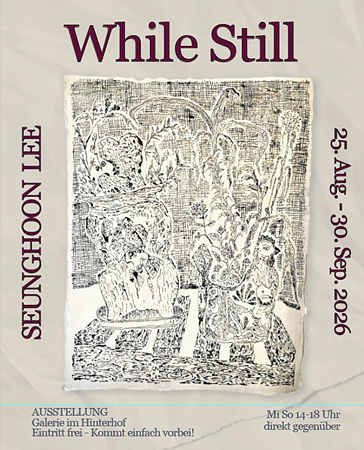
Title: Whie Still
Date : 25. Aug. ~ 30. Sep., 2026
Opening : 25. Aug., Tue., 4 pm
Place : Artertain (Augustastrasse 31, 40477, Duesseldorf. Germany)
Curator : Heeseung Hwang (+82 (0)2-6160-8445)
Dusseldorf,
25 August, 2026
While Still
Time passes. Yet not every moment we experience exists in the same way.
Some moments are so ordinary that they simply pass us by; others break
free from the everyday and become memories. Still others, recurring
in similar forms, remain in our minds as images.
Countless fragments of memory pass through us like trains arriving at
a platform. Some stop only briefly before departing; others leave and
unexpectedly return. In this sense, time resembles a train that continually
sets the platform of our consciousness into motion, a place where memories,
sensations, and images arrive, intersect, disappear, and reappear.
Seen from this perspective, Lee Seunghoon’s artistic practice begins
largely with the moment when time becomes image.
In the animation works that have long formed an important part of his
practice, movement emerges through the temporal succession - the duration
- of countless still images. Each individual image remains motionless,
yet once time enters the interval between one image and the next, we
perceive movement. Even within the brief instant of a blink, an invisible
gap exists between the image that preceded it and the one that follows.
Our senses and memories bridge these interruptions, constructing a continuous
world and allowing us, ultimately, to experience reality as a multidimensional
whole.
Stillness + Time = Movement.
Lee’s recent approach to painting begins by reversing this long-established
principle of animation.
The artist remains before a small potted plant. Working with pen, ink,
and Korean ink - traditional black ink - he places a dot, draws a line,
pauses, and looks again. The subject itself barely moves. Yet throughout
the act of looking, time remains in constant motion. Light changes,
the position of the gaze shifts, and the artist’s body, emotions, and
memories undergo subtle transformations. With each of these changes,
another dot or line is left upon the surface.
Time + Stillness = Painting.
For Lee, drawing is therefore less an attempt to reproduce an object
accurately than an act of reading and recording the temporal and sensory
information that reaches him while he looks.
This attitude resonates with Maurice Merleau-Ponty’s understanding
of embodied perception. For Merleau-Ponty, we are not detached observers
standing outside the world and objectively examining it. We already
exist within the world. Through our bodies, we see, touch, and move
through it, while at the same time being affected and transformed by
it. Perception is therefore not the passive reception of a completed
reality, but an ongoing process through which meaning emerges in the
relationship between body and world.
From this perspective, the potted plants Lee observes are no longer
simply objects of still life.
The duration of his gaze, the posture of his body, the movement of his
hand, the pressure of the pen, memories and emotions, changes in light,
and the repetition of looking all enter the image together with the
subject itself. It also reflects the artist’s conviction that the acts
of seeing and drawing, the perceived object, and the artist’s body
cannot ultimately be separated from one another.
Consider the familiar phenomenon of a well-used ballpoint pen. As it
moves across the paper, ink gradually accumulates around its tip until,
at some unexpected moment, it forms a small clot and settles onto the
surface. In everyday Korean, this insignificant residue is colloquially
called bolpen-ttong?literally, “ballpoint-pen droppings.” Ordinarily
it is regarded as little more than an imperfection in the functioning
of a pen. Seen differently, however, it can be understood as a moment
in which the accumulated duration of the pen’s movement becomes materially
visible.
The repeated dots in Lee’s work can be read in a similar way.
One dot belongs to one moment; the dot beside it already belongs to
another. When hundreds or thousands of dots and lines accumulate into
a single image, we may recognize a plant or a flowerpot. Yet within
that image are layered the many different moments through which the
artist has observed his subject.
Time continues to pass while the artist draws, but within the drawing,
time comes to a halt.
The restrained surfaces composed of black pen, meok, and the untouched
space of the paper should therefore not be understood simply as the
result of removing colour. Rather, as the intensity of chromatic events
recedes, other forms of information become increasingly perceptible:
the distance between one dot and another, the speed of a line, the pressure
of the hand, repetition and interruption, and even the areas where nothing
has been drawn.
In Lee’s work, it is not so much that colour has been reduced; rather,
the conditions for perceiving and evaluating time and sensation have
been intensified.
His restrained palette can therefore be understood not simply as a monochromatic
surface, but as a field in which countless distinct moments coexist
within the same colour.
This development does not represent a simple transition from animation
to painting. Instead, the two practices approach a longstanding artistic
question from opposite directions, revealing the possibility that they
may ultimately converge.
In animation, still images acquire time and become movement.
In painting, time - constantly moving and passing - enters a single
image and comes to rest.
At the centre of both practices remains the same fundamental concern:
the body that sees and the senses that remember.
Lee’s period in Dusseldorf provides an important context in which to
test these questions within a new environment. Removed from familiar
places, language, and the rhythms of everyday life, the body begins
to perceive and read its surroundings at a different pace. The modest
and restrained subject of a potted plant becomes, precisely through
its simplicity, an intimate field of perception onto which the artist’s
sensations and memories of encountering an unfamiliar city can be projected.
This exhibition should therefore be understood not as the presentation
of a completed or fixed artistic style, but as a transitional moment
in which Lee Seunghoon’s practice expands from time-based imagery toward
embodied painting, and from the representation of movement toward the
accumulation of perception.
It is precisely this capacity for transformation that opens an important
possibility for Lee’s work to encounter new audiences in Europe.
Rather than presenting Korean identity through immediately recognizable
cultural symbols, his practice transforms universal questions?time and
the body, memory and perception?into concrete images through personal
experience and the repetition of artistic gestures. In doing so, the
work does not erase cultural difference. Instead, it creates an open
perceptual space in which viewers from different cultural backgrounds
may enter the work through their own experiences of seeing, remembering,
sensing, and passing through time.
Text by Gustav Daishik Yim
|
